


Exclusive-Emails reveal Indian carmakers' fuel contamination worries before public retreat
Exclusive-Emails reveal Indian carmakers' fuel contamination worries before public retreat

By Aditi Shah and Aditya Kalra Thu, August 13, 2026 at 6:01 AM UTC
0
By Aditi Shah and Aditya Kalra
NEW DELHI, Aug 13 (Reuters) - Hours after India made public assurances last week that its ethanol-blended petrol was safe, the country's main auto lobby withdrew a complaint about fuel contamination it had sent to the government a week earlier. The group said some figures needed more checks.
But separate communications between industry executives, reviewed by Reuters, showed that in the preceding days, top automakers Maruti Suzuki, Tata Motors and Mahindra discussed their concerns about contamination of petrol blended with 20% ethanol, called E20.
Their data compiled the most comprehensive fuel testing done by the industry since Prime Minister Narendra Modi's government started rolling out E20 nationwide from last year to help curb pollution and cut oil imports.
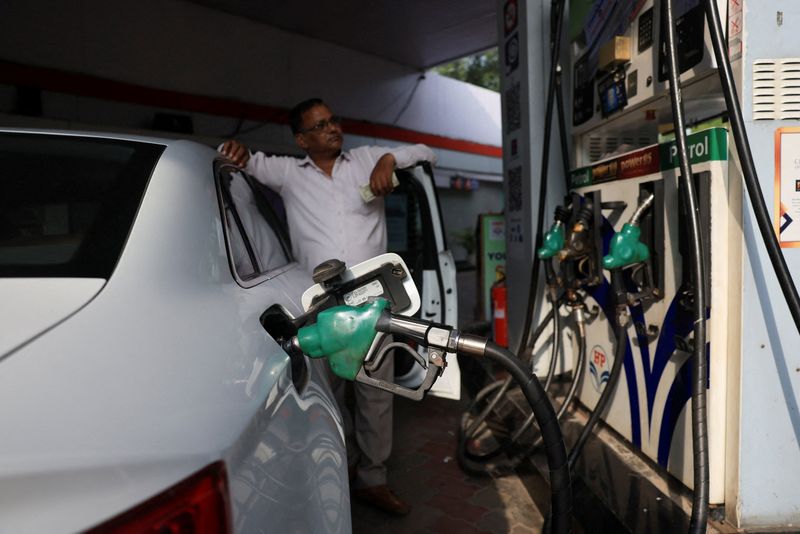
With no other petrol available since April 1, consumer concerns have grown about the impact on vehicle performance.
The carmakers' emails show for the first time how they are privately worried about contaminants in E20, like chloride and moisture, which they say are hurting vehicles, even as they publicly back the government's rollout of the fuel.
The Society of Indian Automobile Manufacturers (SIAM) withdrew its July 28 letter on fuel contamination after a government and public uproar over the warning, saying "some numbers" need "authentication".
The previously unreported industry data and emails reviewed by Reuters show "multiple" automakers had already conducted extensive tests by collecting over 250 fuel samples from pumps over a year from as many as 21 of India's 36 states and territories. They found high chloride contamination in many of the samples in 18 states, as well as high moisture content.
The executives' emails raised no concern about data authentication.
Asked for comment on the private emails, SIAM told Reuters the data was intended only for internal circulation, discussion and validation, and collected by "very few" automakers.
Maruti, Tata and Mahindra, who were part of the SIAM internal emails seen by Reuters, account for 67% of India's car market.
As "the testing basis and sample size were insufficient to support definitive conclusions, the communication was withdrawn" as it was sent inadvertently, SIAM said, adding it intends to undertake a proper scientific study.
The Ministry of Petroleum and Natural Gas did not respond to requests for comment. Its minister, Hardeep Singh Puri, said on Friday that two weeks prior to receiving the letter from SIAM, India's oil marketing companies had begun "rigorous testing" of fuel at retail outlets to check for contamination.
Only four cases of contamination were found, he said. State-run fuel retailers also said last week that extensive random and scientific tests showed "no cause for any alarm on account of fuel contamination".
Mahindra said conclusions drawn from its executive's emails "are completely baseless and incorrect", industry data is limited and preliminary, and it does not see issues with E20. Maruti and Tata did not respond to requests for comment.
Advertisement
E20 has angered motorists, with hundreds alleging it has reduced mileage and increased wear and tear on their cars, and triggered at least one court challenge.
SIAM had earlier said high levels of chloride are corrosive for auto parts, while high moisture levels in fuel can immobilise a vehicle immediately after fuelling.
In the group emails exchanged among Maruti, Tata, Mahindra and SIAM, Maruti's senior executive Anoop Bhat raised concerns on the high chloride findings saying this had been privately discussed with the petroleum ministry on July 26.
The tabulated state-wide findings shared by the industry on group emails showed they recorded chloride levels of 6 to 570 parts per million (ppm) in Rajasthan state, 1.4 to 420 ppm in the capital New Delhi and 10 to 357 ppm in Maharashtra.
The Indian government says the permissible limit is 3 ppm.
The data tables also showed moisture levels reaching 13,000 ppm in Andhra Pradesh and 12,500 ppm in Uttar Pradesh, versus a permissible government benchmark of 3,000 ppm.
While the reason for contamination is not known, SIAM said in its now withdrawn letter it had seen an increase in chloride levels since the rollout of E20 and has requested the government to direct oil marketing companies to find the root cause.
For moisture, the SIAM letter noted, the cause could be inadequate "maintenance of the underground storage tanks and pipelines at retail outlets".
Maruti's Bhat wrote in his July 26 email that 1 ppm of chloride was the maximum that current fuel injectors, which transport fuel to the engine, "can tolerate".
"Lesser than 1 ppm in E20 is also in line with international standards. Same is in line with discussion held with" the petroleum ministry, Bhat wrote.
Mahindra's senior principal engineer of fluids technology, R. Ramaprabhu, said in emails that organic chloride is the contaminant responsible for the very rapid vehicle failures the industry is seeing and can spoil engines "within 200 km".
"Majority cases reported immediately after fuelling ... is due to organic chloride," he wrote, adding that Mahindra has "strong evidences" of fuel sample data from retail outlets.
Mahindra's Ramaprabhu and Maruti's Bhat did not respond to Reuters' queries.
(Reporting by Aditi Shah and Aditya Kalra in New Delhi; Editing by Sonali Paul)
Source: “AOL Money”
