


‘HOTD’ Finale: Emma D’Arcy Explains Rhaenyra’s Tyranny & Alicent’s Future
‘HOTD’ Finale: Emma D’Arcy Explains Rhaenyra’s Tyranny & Alicent’s Future

Kelli BoyleMon, August 10, 2026 at 2:10 AM UTC
0
Emma D'arcy as Rhaeynra Targaryen in 'House of the Dragon' Season 3 finale - HBO
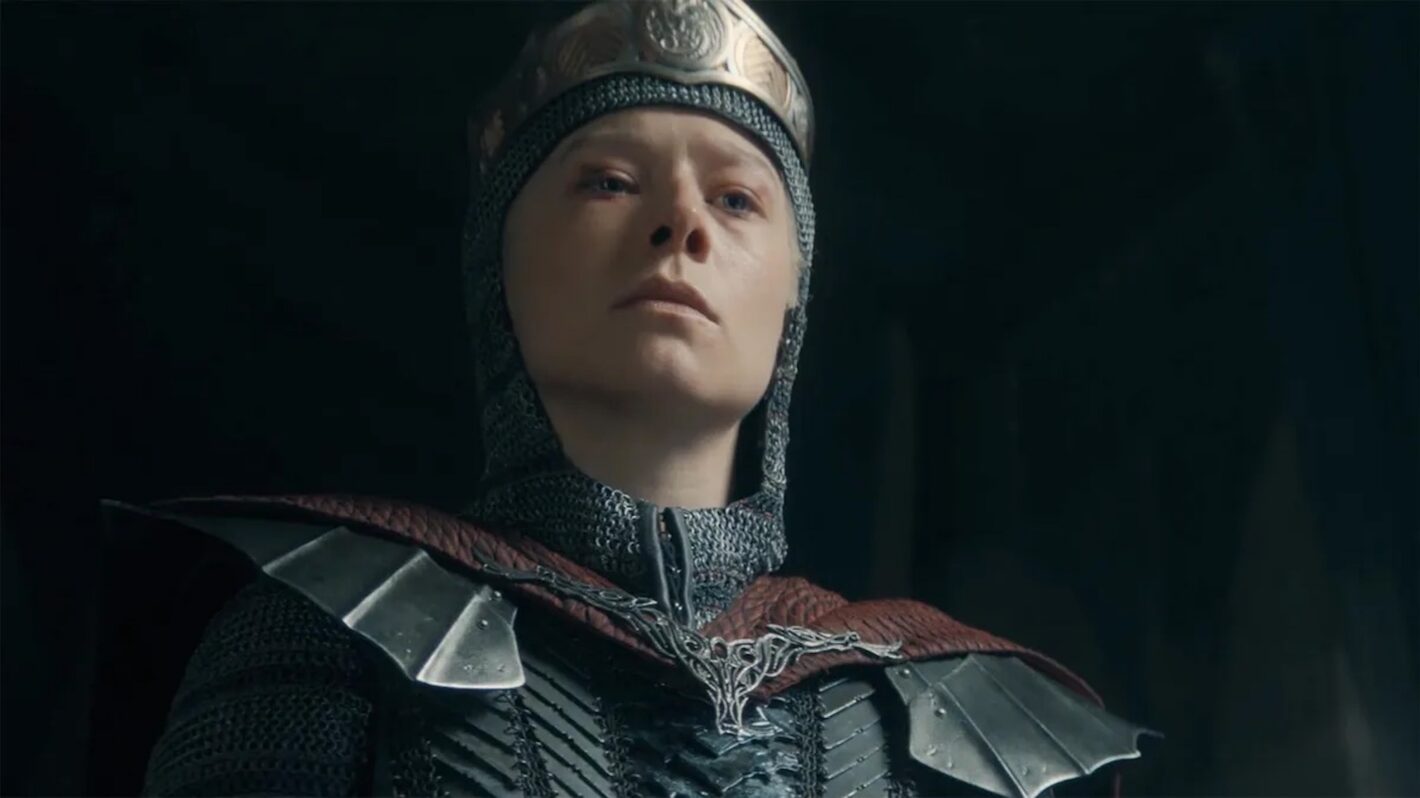
The cost of the Iron Throne and the efforts to maintain it have changed Queen Rhaenyra Targaryen (Emma D’Arcy) forever in the House of the Dragon Season 3 finale. The loss of her two eldest sons in quick succession in the Targaryen civil war threw Rhaenyra into the pits of grief that she didn’t have time to process as she and her supporters fought to reclaim the seat of power that was stolen from her by her half-siblings and their Hightower family.
To make sense of her grief, Rhaenyra sought proof of her divine right to rule in others in Season 3. Here, D’Arcy and series co-creator Ryan Condal explain how Rhaenyra’s internal conflicts were represented by her relationships with Daemon (Matt Smith), Alicent (Olivia Cooke), and Mysaria (Sonoya Mizuno) this season, and how the events of each episode dug Rhaenyra deeper into her descent into tyrannical behavior that may have reached a point of no return in the final moments of the August 9 season finale. The final season of House of the Dragon is set to come out in 2028 on HBO. Warning: House of the Dragon Season 3 finale spoilers ahead.
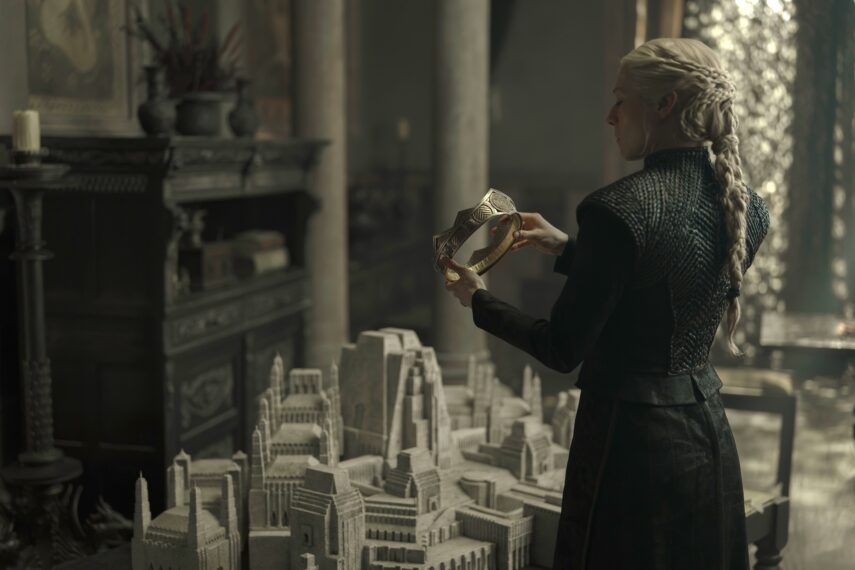
The return of Aegon (Tom Glynn-Carney) and his maimed dragon Sunfyre sent Rhaenyra into a panic and the citizens of King’s Landing into confusion. Rhaenyra and her allies set out to do PR damage control in the capital city, while the queen sent husband Daemon to Tumbleton to attack the duplicitous Ormund Hightower (James Norton) and his forces that had occupied the city in a scheme to put Alicent’s youngest son, Daeron (Benjamin Evan Ainsworth), on the Iron Throne.
Related
'House of the Dragon': Fabien Frankel Reflects on George R.R. Martin's Criston Cole Casting Announcement
Ulf’s (Tom Bennett) betrayal in Tumbleton caused severe damage on both sides. Back at home, the pregnant and captive Helaena (Phia Saban) reached a psychological breaking point and ended her own life by jumping out of the window of her room in the Red Keep, where Rhaenyra had previously ordered knights to force-feed her to end her refusal to eat.
Earlier, out in the city, Rhaenyra ordered the High Septon to anoint her as queen. He refused, citing Aegon’s “resurrection” as a sign of the gods’ desire for him to rule. Rhaenyra ordered the fiercely loyal Alyn (Abubakar Salim) to kill the Septon, and he did what was demanded. With the religious leader dead in the Dragonpit, Rhaenyra spoke to her subjects on the streets of the city and told them the song of ice and fire that was passed down to her by Viserys (Paddy Considine) and every other Targaryen king before them (she told it to son Joffrey earlier in the episode). Rhaenyra called herself “the prince that was promised,” a line Game of Thrones fans will recall.
The episode ended with Helaena’s suicide and Rhaenyra seeing her sister’s prophetic tapestry that hung from the window afterward. The story Helaena sewed into the fabric showed Rhaenyra burning alive on the Iron Throne. Rhaenyra ignored this sign that contradicted her belief in her right to rule, closed Helaena’s window, and the season ended.
In a finale press conference with journalists, D’Arcy said that Rhaenyra, unsurprisingly, is unaware of her tyrannical behavior, and any other character’s culpability in her descent into this dangerous mindset, for that matter. Alicent’s culpability in the events that began the war, as well as her relationship with Rhaenyra, seems to be the undercurrent connecting each season.
Theo Whiteman/HBO
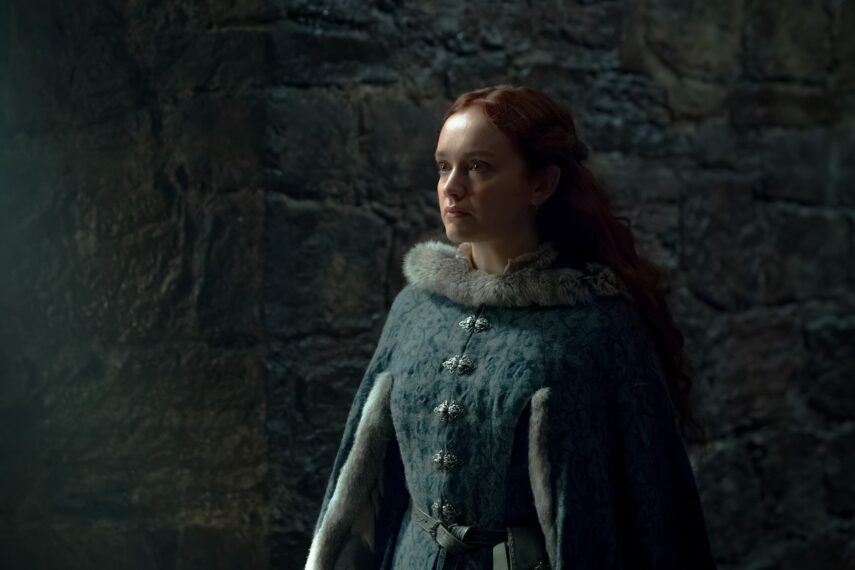
“It’s hard for me to say whether Rhaenyra recognizes Alicent’s culpability, because I’m not sure that Rhaenyra recognizes that her leadership is becoming increasingly tyrannical, at least not for most of Season 3,” D’Arcy told TV Insider. “I’ve really enjoyed their relationship this season. I think in part because there’s a nice thing where Rhaenyra’s constituent parts got externalized this year in some way. Daemon is the ego, Mysaria the conscience, and Alicent is the judge.”
“I really like the idea of locking your judge up in the basement, but then periodically going down to check in with them about how you’re doing,” D’Arcy said of Alicent. “Something about that feels very truthful, although it’s bizarre and abstract.”
D’Arcy thinks that Helaena’s death is the point of no return, not only for Rhaenyra and Alicent’s relationship, but any hope that Rhaenyra could put an end to her tyrannical behavior.
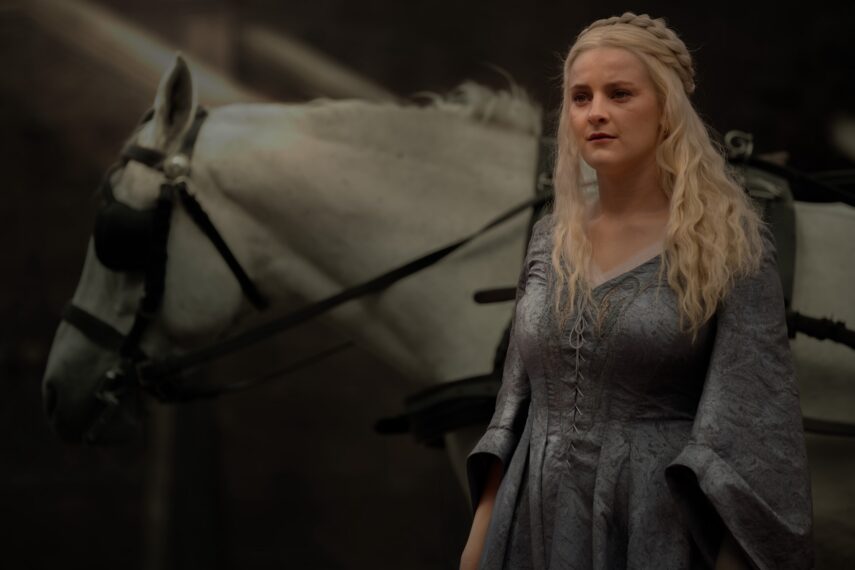
“Helaena is the moral heart of the show, I think. She’s maybe the only character who has a proximity to power, but remains kind of uncontaminated,” D’Arcy pointed out. “Her death condemns Rhaenyra to the path she’s chosen. There’s no way back after that. There’s certainly no route back to a kind of more moderate form of leadership. I don’t know where we go from here, but I imagine it’s likely to be impassable in her relationship with Alicent, which I think also means Helaena’s death condemns Rhaenyra to be alone in her pursuit for power.”
Ollie Upton/HBO
Advertisement
D’Arcy said they thought a lot about “[Rhaenyra’s] rejection of the Seven and murder of the High Septon, and this attempt to reject other legitimizing institutions” in regards to the finale. “And in a funny way, Helaena’s power of sight is another kind of institution of legitimacy. I just love the simplicity of looking at a document [Helaena’s tapestry] that could be hugely illuminating, but choosing it to chuck it on the floor.”
Related
'House of the Dragon' Star Says Fans Are Wrong About Alys and Aemond
Alicent’s misunderstanding of Viserys’ final words to her triggered the beginning of the civil war. Her father, Otto Hightower (Rhys Ifans), and his allies had been secretly planning to usurp the throne in favor of Aegon, but then they were able to use Viserys’ so-called final wish to their advantage and conceal their treachery. Rhaenyra was previously the most level-headed leader in this conflict, one who was resistant to sending the dragons into battle out of a commitment to her father’s leadership.
It was that restraint that earned Rhaenyra the respect and support of Rhaenys (Eve Best), but the trauma of losing her sons, losing her daughter in childbirth, and the psychological struggle of fighting back against the belief that women can’t rule broke something in Rhaenyra. In the Season 3 finale, she chose to follow Daemon’s violent methods, which Condal said came from a belief that acting like a violent man was the only way to be seen as legitimate.
It’s “the realm writ large” that is culpable for Rhaenyra’s psychological break, Condal told us. “This whole story, since really the first episode, has always been about can this realm accept a woman as a leader? And what will it do when faced with that as not just an eventuality, but it’s here and now, and what’s happening? And then for Rhaenyra, and for Emma’s side of the story, how does that impact Rhaenyra’s ability to lead?”
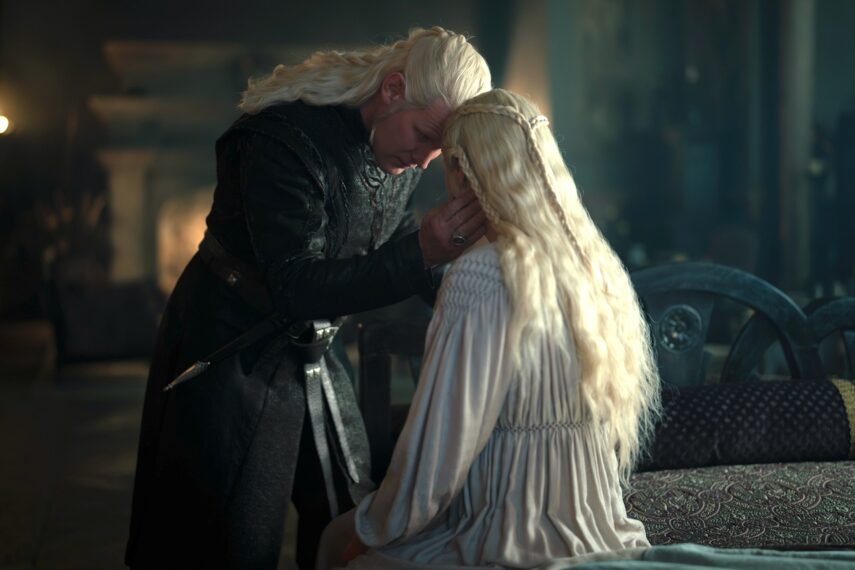
Ollie Upton/HBO
Condal continued: “So much of this season was, and I think Emma illustrated it beautifully with the conscience, the judge, and the ego, we had always looked at Rhaenyra being torn between Viserys’ philosophy, which is somewhat embodied by Mysaria, it’s somewhat embodied by Alicent in her conversations with them, and then Daemon, which is the fire and blood, ruled by dragons, uncompromising. It’s very, very black and white to him and his empire building and his dreams and ambitions, all the reasons that Viserys passed him over to be king.”
Related
'House of the Dragon' Star on Daeron's 'Turning Point' After Shocking Attack
The showrunner explained, “Rhaenyra is torn between those two avenues: Asking yourself, can I rule as a woman during a time of war and still be true to the reasons that Viserys chose me to rule? Or do I simply just have to become Daemon in order to win and to hold this whole thing together? From Rhaenyra’s perspective, it wouldn’t be to be an authoritarian, it would just simply be to keep control, to hold the center. She has to make all these compromises as she goes along, and then finally she literally casts Mysaria out and throws in totally with Daemon in the end, thinking that that’s her only way to be seen as legitimate to all of the lords and the people that she’s so reliant on in the end.”
D’Arcy also broke down Rhaenyra’s quick unraveling after Aegon’s return.
“I really, really wanted to make sure that that journey was a legible one,” they said. “If we’re to be more practiced at protecting democracy, which seems increasingly fragile at times, we have to be smarter about understanding the behaviors of dictatorial leaders. This was an opportunity to try and make a certain type of behavior understood by an audience. And from an acting perspective, it felt much more playable to think about empathy and the empathetic machine and how that gets damaged and affected by events than it did to solely think about her relationship with authoritarianism.”
Condal will soon return to writing the fourth and final season of the Game of Thrones spinoff. He said that they knew Season 4 would be the last when they were creating the story for Season 3, so the key events of the final two seasons were mapped out together.
“Once we knew where we were in it, it just kind of flowed out of us,” Condal said.
“We have an incredible season coming,” he added. “As crazy and big as Season 3 was, I think Season 4 is going to be even bigger. It’s a great privilege to be able to tell a story, and to be able to control and write the ending, and to control when and where that happens. This is not a given in making television, certainly. So, we’re very excited to get back in, and we have new characters, and new dragons and new locations all to come that I think are gonna make it a very worthy final season. And I’m looking forward to doing it with one of my favorite people in the world, Emma D’Arcy.”
House of the Dragon, Season 4 Premiere, 2028, HBO, Seasons 1-3 Streaming on HBO Max
Read the latest entertainment news on TV Insider.
Source: “AOL Entertainment”
